

Florida Condo: Straight-Line vs. Pooled Reserves
The primary difference between Florida condo reserve methods is how the money is distributed: the straight-line method strictly locks funds into separate line-item accounts for each individual building component, while the pooled method combines funds into a unified cash-flow account.
Under current Florida condominium laws, associations can legally use either strategy to satisfy their budgeting obligations.
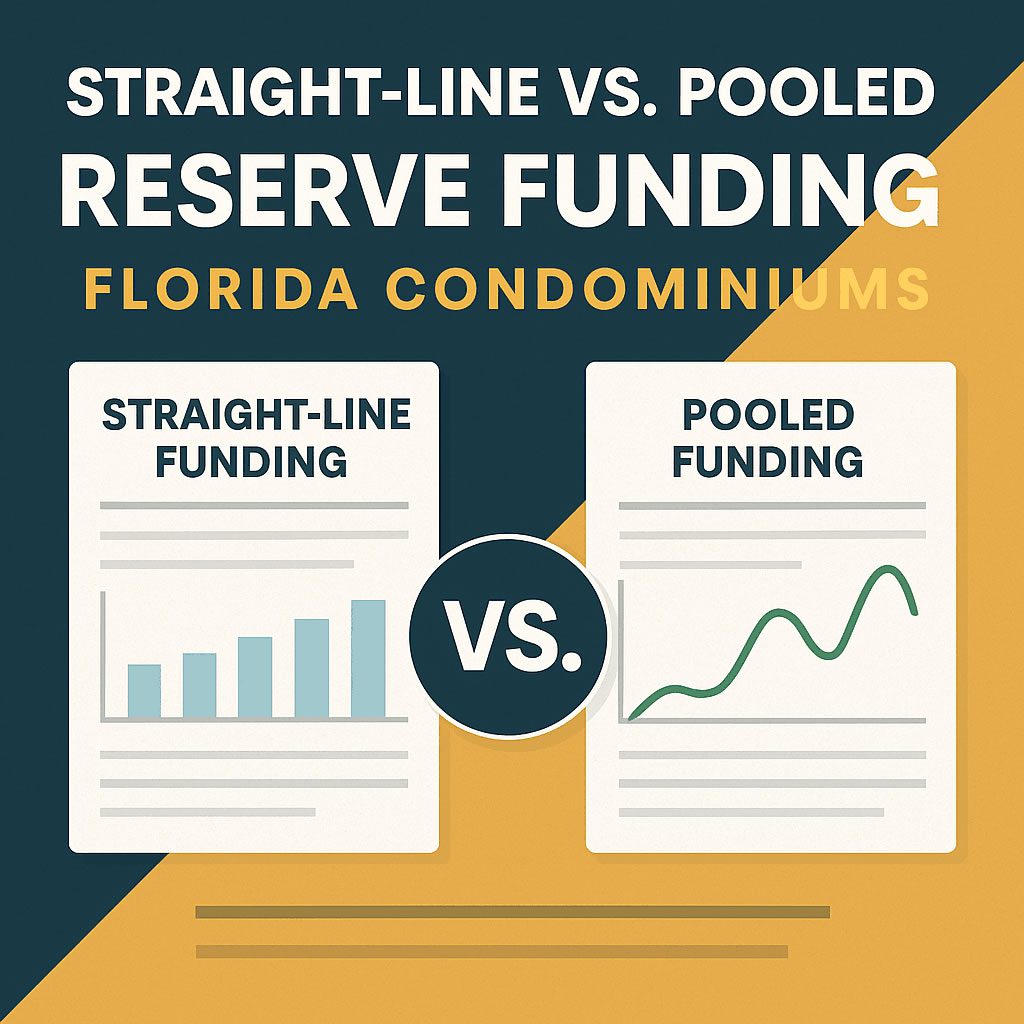
Core Comparison: Straight-Line vs. Pooled Reserves
- Account Setup
Straight-Line: Individual, restricted allocations for each asset, such as roof, paint, and pavement.
Pooled: One master account holding funds for all included components. - Flexibility
Straight-Line: Low. Money allocated for painting cannot be used for a roofing emergency.
Pooled: High. The board can use the total cash pool to pay for any item within that pool. - Near-Term Cost
Straight-Line: Usually higher annual assessments to ensure every separate allocation is fully funded.
Pooled: Usually lower annual assessments because cash is optimized across timelines. - Owner Vote
Straight-Line: Required if the board wishes to shift funds between straight-line accounts.
Pooled: No unit owner vote is required to spend from the general pool for listed items. - Required Formula
Straight-Line: Estimated replacement cost minus current funds, divided by remaining useful life.
Pooled: 30-year cash-flow projection ensuring the balance never drops below zero.
The Straight-Line Method
Often referred to by CPAs as the Component Method, this treats your reserve fund like a collection of separate savings envelopes. The math works as follows: if a roof costs one hundred thousand dollars to replace and has ten years of life left, the association must collect exactly ten thousand dollars per year for that specific line item. The advantage is that it provides extreme transparency. Every homeowner can see precisely how much money is allocated for every single structural piece of the building. The disadvantage is that it is highly inefficient. An association might have fifty thousand dollars sitting idly in a pavement fund that cannot legally be touched, while the roofing account faces an emergency deficit.
The Pooled Method
Often called the Cash-Flow Method, this treats reserves as a singular pool of money. Instead of calculating individual items independently, a 30-year analysis evaluates when all major expenses occur. Annual contribution rates are normalized so that the total pool balance remains safely above zero, or a baseline threshold, at all times. The advantage is that it dramatically reduces near-term financial pressure on unit owners. Funds do not sit trapped in unusable balances, freeing up capital to target actual, immediate building needs. The disadvantage is that boards must manage cash flows meticulously. If multiple assets fail ahead of schedule, the pool can be depleted rapidly.
JLV COA operates using the Pooled Method
JLV COA manages its reserve funds through the pooled, or cash-flow, approach. Rather than segregating money into separate, restricted accounts for each building component, the association consolidates all reserve funds into a single master account. This structure allows the board to draw from the total cash pool to address any included maintenance or replacement need as it arises, without requiring a unit owner vote for reallocation. By using a 30-year cash-flow projection to smooth annual contribution rates, JLV keeps near-term assessments more manageable for owners while ensuring the overall balance remains above zero at all times. However, this strategy demands careful ongoing oversight, as the board must actively monitor spending and timing to prevent premature depletion of the pool if multiple major assets require attention sooner than projected.